
How to Find Who Owns a Marquette County Property
Two records answer the ownership question in Marquette County. The assessor's parcel file, or its FetchGIS report, gives the current administrative name, mailing address, parcel number, unit, and tax year. The newest deed gives the rest. It names the recorded grantee and restates the legal description. Names can disagree after a recent sale. When they do, date both records and let Equalization and the Register of Deeds confirm which one is still in processing, instead of guessing.
- Record the source, date, parcel number, legal description, and office response before moving to the next source.
- Record the source, date, parcel number, legal description, and office response before moving to the next source.
- Record the source, date, parcel number, legal description, and office response before moving to the next source.
- Record the source, date, parcel number, legal description, and office response before moving to the next source.
Where Marquette County Owner Information Comes From
Ownership data in Marquette County flows from two places. Assessors keep the administrative side. That means the owner name used for the tax roll, plus the mailing address. The parcel number, unit, and tax year live there too. The deed side lives with the Register of Deeds. Each recorded conveyance names its grantee there. It also fixes the legal description. A sale can leave the two out of step briefly. Date both records, then ask Equalization and the Register of Deeds to confirm processing rather than assume.
| Source | Owner Info It Gives | Access |
|---|---|---|
| Assessor / tax roll | Confirm the current field with the official custodian. | Confirm the current field with the official custodian. |
| Recorder deed index | Confirm the current field with the official custodian. | Confirm the current field with the official custodian. |
| Secretary of State | Confirm the current field with the official custodian. | Confirm the current field with the official custodian. |
| GIS parcel viewer | Confirm the current field with the official custodian. | Confirm the current field with the official custodian. |
Marquette County never stores ownership in one place. One record is administrative. The assessor, through the FetchGIS report, posts the current name, mailing address, parcel number, unit, and tax year. The other record is legal. The most recent deed names the recorded grantee and carries the legal description that controls the land itself. A fresh sale can make the two disagree. Date each one, and ask Equalization and the Register of Deeds to confirm where processing stands.
What "Who Owns This Property" Cannot Tell You
Knowing the owner of record has limits. The assessor's FetchGIS report gives the administrative name. It also gives the mailing address, parcel number, unit, and tax year. The latest deed gives the recorded grantee and legal description. Neither fact tells you who lives there. It also cannot tell you who holds beneficial interests, or whether a trust sits behind the named owner. If the two records disagree after a recent sale, date them. Then ask Equalization and the Register of Deeds to confirm processing rather than guessing.
Lawful use. Owner lookups support lawful property research. Public names and mailing fields must never be used to harass or intimidate anyone.
Offline Marquette County Access
Owner of record, grantee, and occupant are different things. The tax roll names the person or entity assessed, and shows where notices get mailed. The deed names the grantee in a recorded conveyance. A trust, an estate, a life estate, or a company may stand in for an individual. When names diverge, compare record dates and legal descriptions, check Probate Court P52 or the Michigan business registry where they apply, and ask Equalization and the Register of Deeds to confirm their own files.
Online records leave gaps. For a missing date range or image, use the counter, the phone, a mailed request, a Michigan FOIA request, or the named archive.
The official source shown here is the starting point for this record type.
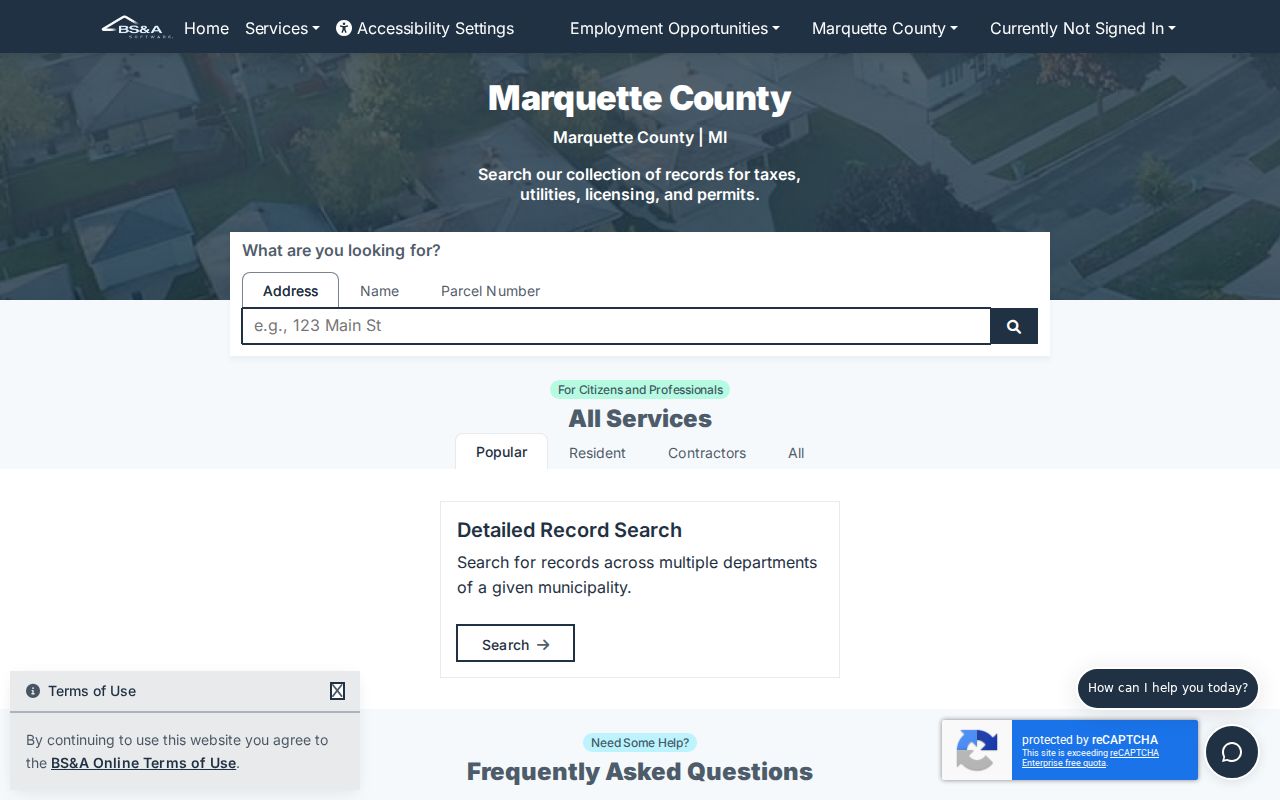
Marquette County's official page lists the public access routes.
Marquette County Entity Owners
An LLC or corporation can hold both the deed and the assessment. Run the exact entity name through Michigan's MiBusiness Registry. It will show the formal record and the registered agent. Then return to the deed for the land interest itself. A trust may hide behind spelling variants and trustee names. An estate or personal representative may link to Probate Court P52. A later representative deed may follow.
Those supporting records explain names. They do not replace the conveyance. Beneficial ownership, possession, mailing destination, and record title can all differ. The soundest answer states which name appears in which dated source.
Marquette County Owner Conflicts
Compare dates first when the roll and deed disagree. A new deed may reach the Register of Deeds first. The local assessor finishes the ownership update later. A tax bill may keep an older mailing address. The county publishes no fixed closing-to-roll delay. No standard number of days can be promised. Call Equalization at (906) 225-8405 about the ownership and description roll. Call the Register of Deeds at (906) 225-8415 about the recorded instrument. Keep the legal description constant while the names get reconciled.
Marquette County Ownership Sources
The assessment roll is the fastest route to the owner name behind the tax bill. FetchGIS adds a map. It also provides verified Owner Address, Property Address, Unit, APN, tax year, class, school district, and value fields. The deed index supplies the recorded grantee and date. A city zoning map adds land-use context only. None of these alone proves possession. It does not settle every title interest. It does not replace a professional title search.
Search failures usually have simple fixes. Normalize the street, and test or drop directionals. Verify the ZIP, and pick the right city or township unit. For a failed owner-name search, try initials. Former names, trust or estate wording, and business suffixes can also help. If the recorder search stalls, use the legal description instead of the APN. Marquette County does not offer parcel number as an online deed-search key.
Older ownership takes a courthouse visit. Deeds before 1980 and mortgages or miscellaneous instruments before 1983 fall outside the online cutoff. Recorder books, historic plats, and archival guides can each supply a next clue. Local newspapers and directories can too. Every clue must reconcile to the same legal description.
Marquette County Research Check
Finding an owner has a privacy boundary. Michigan's Address Confidentiality Program lets eligible participants use a designated substitute address. Never try to reverse that into a physical location. An owner address in a public record should be treated as a field the government displays, not proof that someone lives there or an invitation to show up at the door. Directory data adds its own problems, since commercial listings can be stale, blended, or tied to the wrong parcel. Assessment rolls and deed records are stronger sources. Their keeper, purpose, and date can all be stated plainly. Even so, official property records have limits. An assessor card is not a title opinion. A plat map is not a survey. A deed index may omit unrecorded interests or details visible only in the recorded image. For purchase due diligence, estate work, deed-fraud review, or a boundary question, verify the relevant instrument and bring in a qualified professional when the legal conclusion matters.