
Tracing Former Owners of a Marquette County Property
Every Marquette County property search for past owners starts with the land itself. The legal description is the anchor. Pull the newest deed for the current owner of record. Note who signed as grantor. Then hunt for that grantor's own acquiring deed. Keep walking the chain backward. Stop the moment the lot, block, addition, or section-township-range description stops matching. Plats such as Edward's Addition, Hiram Burt's Addition, Salisbury Location, and Iron Plat Addition help. They give strong search terms in local deed records.
| Source | Years It Covers | Where Held | What It Shows |
|---|---|---|---|
| Confirm the current field with the official custodian. | Confirm the current field with the official custodian. | Confirm the current field with the official custodian. | Confirm the current field with the official custodian. |
| Confirm the current field with the official custodian. | Confirm the current field with the official custodian. | Confirm the current field with the official custodian. | Confirm the current field with the official custodian. |
| Confirm the current field with the official custodian. | Confirm the current field with the official custodian. | Confirm the current field with the official custodian. | Confirm the current field with the official custodian. |
| Confirm the current field with the official custodian. | Confirm the current field with the official custodian. | Confirm the current field with the official custodian. | Confirm the current field with the official custodian. |
Stable land descriptions hold a backward deed chain together. Begin with the present grantee in the Marquette County deed records. Open the most recent deed. The named grantor becomes your next target. Find where that party acquired the parcel, then repeat the step. The method works only while the lot, block, addition, or section-township-range language stays consistent. Named plats help too. Try Edward's Addition, Hiram Burt's Addition, Salisbury Location, and Iron Plat Addition as search terms.
Walking the Marquette County Deed Chain Backward
Walking the Marquette County deed chain backward is a loop. Search the current grantee first. The newest deed names the grantor. Track that grantor to the earlier acquisition, then repeat the cycle for each new name. The chain stays valid only while the description keeps matching. The lot, block, addition, or section-township-range description must match what you started with. Local plat names add leverage. Edward's Addition, Hiram Burt's Addition, Salisbury Location, and Iron Plat Addition all appear in county deed records. They make useful search terms.
- Record the source, date, parcel number, legal description, and office response before moving to the next source.
- Record the source, date, parcel number, legal description, and office response before moving to the next source.
- Record the source, date, parcel number, legal description, and office response before moving to the next source.
- Record the source, date, parcel number, legal description, and office response before moving to the next source.
- Grantor / grantee
- The transferor and recipient named in a deed.
- Chain of title
- The chain formed by matching each transfer to the same land.
- Legal description
- The stable land wording used when street names or numbers change.
How Far Back Marquette County Ownership Records Go
How deep can a Marquette County property search go? As far as the land descriptions hold. Start with the current grantee and the newest recorded deed. Identify the grantor on that instrument. Use the grantor's name to locate the earlier deed transferring the same parcel. Repeat while the lot, block, addition, or section-township-range description continues to match the tract. Addition names sharpen the hunt in older deed records. Look for Edward's, Hiram Burt's, Salisbury Location, and Iron Plat Addition.
Lawful use. Former-owner records support house history and property diligence. They must never be used to track, intimidate, or harass a living person.
Offline Marquette County Access
A deed chain should read as a chronology, not a pile of similar surnames. Record each transfer's date, grantor, grantee, deed type, and book and page or instrument number. Include the full legal description too. Then move from each grantor to the deed by which that party first took title. Expect interruptions. Probate transfers, personal-representative deeds, plats, and street vacations can all appear. Older unindexed instruments can too. Any of these can break a simple chain in Marquette County deed records.
Local newspapers help fill the story around the records. The Mining Journal, Negaunee Iron Herald, and Ishpeming Iron Ore carried estate and sale notices. Those notices lead somewhere, but they never replace the recorded deed itself.
Online property records leave gaps. When a date range or image is missing, use the counter or a phone call. A mailed request works too. So does a Michigan FOIA request or the named archive.
The official source shown here is the starting point for this record type.
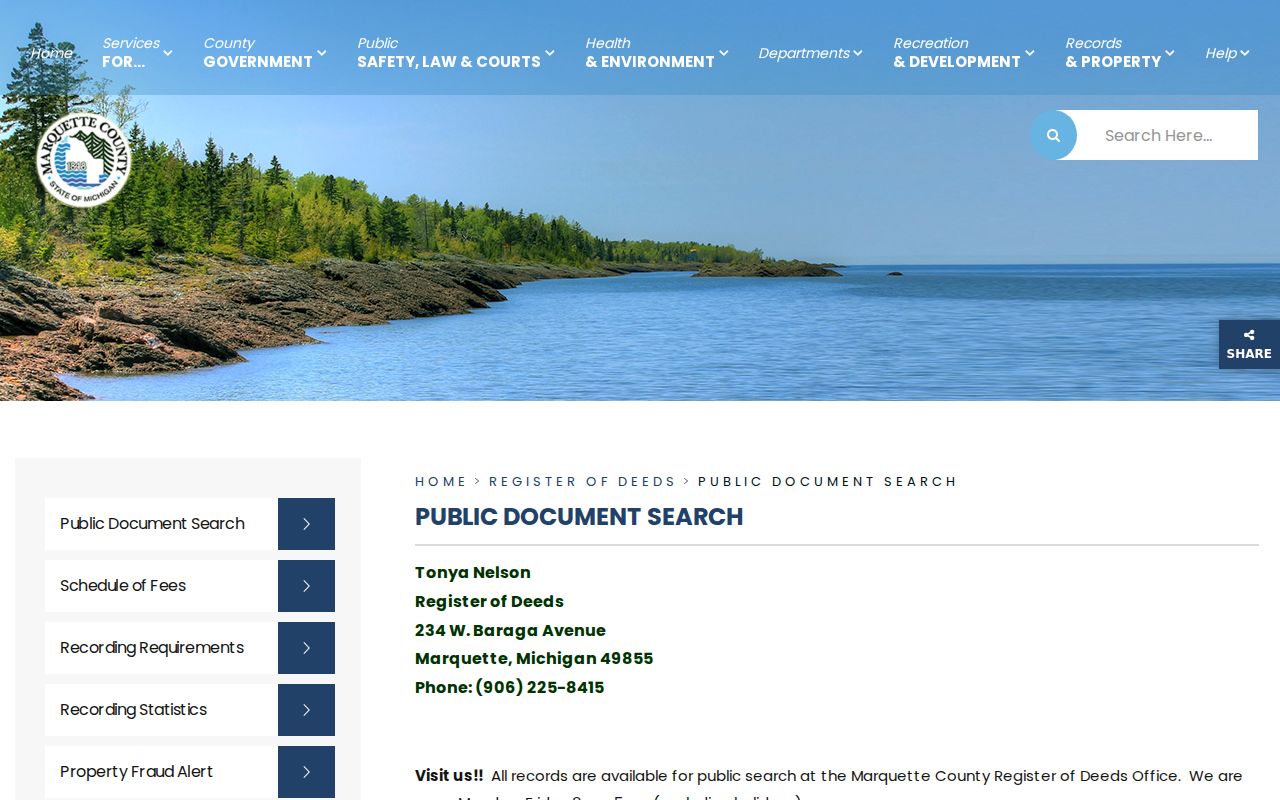
Note: The official Marquette County page displays the public access route for the records described here.
Marquette County History Sources
The Marquette County Register of Deeds reports that physical land records reach back to the 1800s. The online index starts in 1980. That leaves a long stretch of paper. The Archives of Michigan county guide and the Library of Michigan Marquette guide extend the trail beyond the courthouse. NMU's Central Upper Peninsula collections do too. Their holdings include newspaper runs, county histories, cemetery material, and archive record groups. These can clarify an estate, a company, or an old place name.
Every archive clue should lead back to a deed book or recorded plat. FamilySearch lists no confirmed current Marquette County deed collection. Treat its catalog as a way to locate a book or film before checking access.
Marquette County Chain Breaks
Gaps in a Marquette County deed chain usually have an explanation. A probate case may show why a decedent or an estate stayed on the tax roll. A personal-representative deed ends that wait. A plat vacation or a renamed street can make an old address vanish. Mortgage assignments and discharges run as a parallel sequence. They never prove the ownership transfer itself. The county records no courthouse fire or lost-record event. An unexplained gap therefore deserves a harder look rather than a convenient blame.
Exact addition names unlock older tracts. Use Edward's, Hiram Burt's, Homestead, Salisbury, Barnum, Hard Ore, or Iron Plat. Apply them where the legal description supports it. Mining-company names and common surnames demand initials, dates, and careful tract matching.
Marquette County Research Check
Marquette County's record history spans several systems. The county organized in 1851. Nineteenth-century land books, early marriage and vital registers, mining and railroad newspapers, and later digital indexes each carry their own search conventions. A chain crossing 1980 should shift from online names to counter books. That switch reflects a change in format, not a records loss.
Historic directories tempt researchers. They may list an occupant, spouse, occupation, or address notation. They do not control ownership. Pair any directory hit with the nearest deed, tax roll, census entry, probate file, and plat. Planning packets deserve the same caution. A packet can expose a file number, APN, old addition, hearing date, or vacated street. Only the final recorded instrument changes the deed trail.
Cite former owners with the transfer date and tract. If a link rests on a newspaper or directory clue alone, label it a lead and keep searching the property records.