
What Marquette County Property Tax Records Show
The assessment roll is the heart of Marquette County property tax records. Equalization maintains it for 19 townships and the county's cities. It also provides ownership descriptions, maps, and help with appeals. Each roll entry traces back to a parcel. Current bills stay with the local unit until March 1. After that, the County Treasurer handles delinquent real-property tax. The Treasurer offers a free initial search with detailed information. It can also compile up to 20 years of tax history at $0.25 per billing per parcel per year.
| Field | What It Shows | Where |
|---|---|---|
| Assessed value | Confirm the current field with the official custodian. | Confirm the current field with the official custodian. |
| Market / appraised value | Confirm the current field with the official custodian. | Confirm the current field with the official custodian. |
| Exemptions | Confirm the current field with the official custodian. | Confirm the current field with the official custodian. |
| Tax bill & status | Confirm the current field with the official custodian. | Confirm the current field with the official custodian. |
| Taxing districts | Confirm the current field with the official custodian. | Confirm the current field with the official custodian. |
Marquette County property tax records describe every taxable parcel in the county. Equalization supports 19 townships and the cities with ownership descriptions, assessment rolls, maps, and appeal assistance. The current tax bill is a local matter first. Local units keep it until March 1. Delinquent real-property tax then shifts to the County Treasurer. The Treasurer's free initial search returns detailed information. Staff can prepare up to 20 years of history at $0.25 per billing, per parcel, per year.
Looking Up a Marquette County Tax Bill
Looking up a Marquette County tax bill means knowing which office holds it. The bill starts with your city or township. That local unit keeps the account until March 1. Delinquent real-property tax moves to the County Treasurer. The Treasurer offers a free initial search with detailed information and can build up to 20 years of tax history at $0.25 per billing per parcel per year. Equalization rounds out the picture for 19 townships and the cities. It supplies ownership descriptions, assessment rolls, maps, and appeal help.
- Record the source, date, parcel number, legal description, and office response before moving to the next source.
- Record the source, date, parcel number, legal description, and office response before moving to the next source.
- Record the source, date, parcel number, legal description, and office response before moving to the next source.
- Record the source, date, parcel number, legal description, and office response before moving to the next source.
- Assessed value
- The assessor figure used within Michigan’s tax system.
- Mill rate / levy
- A rate expressed per thousand dollars of taxable value.
- Homestead exemption
- A classification or exemption that must be confirmed with the local assessor.
- Tax lien
- A governmental claim tied to unpaid property tax.
Appealing a Marquette County Assessment
An appeal in Marquette County begins with Equalization's paper trail. The office supports 19 townships and the county's cities. It supplies ownership descriptions, assessment rolls, maps, and appeal help. Timing matters. The current bill stays with the local unit until March 1. The County Treasurer then manages delinquent real-property tax. The office provides a free initial search with detailed information. It can also produce up to 20 years of tax history at $0.25 per billing per parcel per year to back your case.
Appeal window. Use the current assessment notice and Michigan L-4035 petition, then confirm the local Board of Review session and filing requirements before the stated deadline.
Offline Marquette County Access
Michigan splits value three ways: assessed, state equalized, and taxable. Assessment commonly targets 50 percent of true cash value. Proposal A caps annual taxable-value growth until a transfer uncaps it. Your assessment notice and the current Board of Review forms come from the local unit. Older history runs through the County Treasurer. Bring both a taxpayer name and a property number. Anything beyond the county's 20-year request range goes to the Northern Michigan University Archives. A date range or image may be missing online. Use the responsible counter, a phone call, a mailed request, a Michigan FOIA request, or the named archive instead.
The official source shown here is the starting point for this record type.
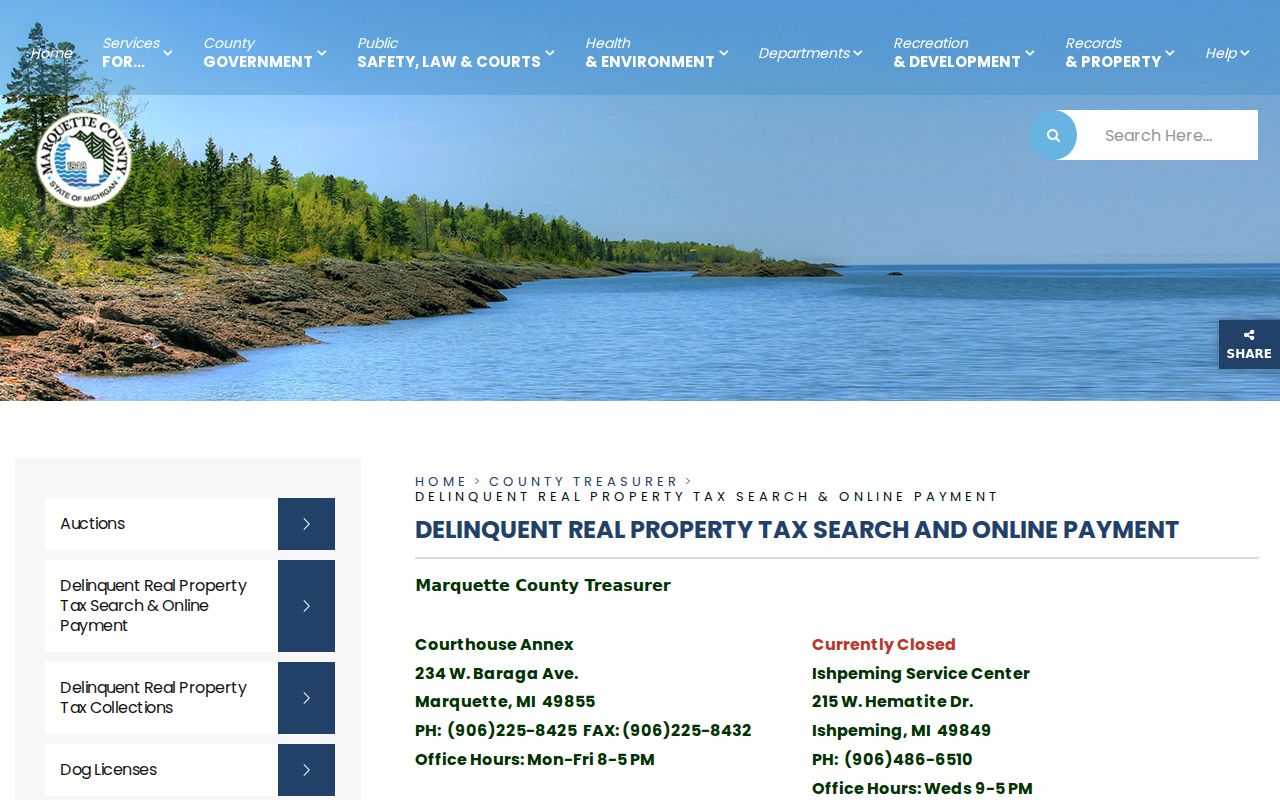
The county's delinquent-tax page shows the public access route.
Marquette County Tax Values
Marquette County tax values sit inside Michigan's 50 percent assessment framework. Assessed value and state equalized value move together. Taxable value follows a different Proposal A path. Annual limits apply before a transfer. A sale can uncap it. A change in taxable value therefore says nothing certain about market price. Before comparing years, save the tax year, class, unit, exemption status, and both value fields. The roll's owner and mailing address are administrative fields. They can lag a new deed or route notices elsewhere. Equalization keeps the county ownership and description records. Local assessors run the current rolls and Board of Review work. When the question is a transfer rather than tax administration, a recent deed remains the stronger dated source.
Marquette County Delinquency
Delinquent Marquette County real-property tax belongs to the County Treasurer after March 1. The county allows a 25-month payment period with rising interest and fees. Partial payments are possible. A hardship-extension route exists for qualifying owners. Foreclosed parcels go to an August minimum-bid auction and an October no-minimum-bid auction. Winning bidders receive quitclaim deeds. A tax-sale listing is not proof of clear title. Check the delinquent balance, recorded foreclosure instruments, auction terms, and any Circuit Court surplus-proceeds matter, because current personal-property tax and current real-property bills stay outside this county delinquent workflow.
Marquette County Tax Channels
Each Marquette County tax question has one right office. The local assessor answers questions about current assessment and classification. It also handles exemption and the Board of Review process. The city or township treasurer handles the current July or December bill before delinquency. County Equalization maintains ownership and description records, rolls, maps, and county equalization work. The County Treasurer answers delinquent real-property tax after March 1. It also takes tax-history requests, foreclosure administration, auctions, and county plat-book sales. Personal-property tax never travels the county delinquent real-property route. Start with the free delinquent search. It establishes whether a county record exists at all. Owners can create an account and pull their own property detail without a charge. GovPros payment fees sit apart from the tax itself. The county page lists 2.5 percent for credit, 4 percent for American Express, 1.5 percent for debit, and a $0.50 minimum. Confirm those figures live before paying, since processor terms can change. An appeal starts with the assessment notice and the local calendar. It never starts at the county delinquent page. Michigan publishes the L-4035 petition and the L-4400 assessment notice resources. Bring the parcel record. Bring the challenged figures too. Add dated comparable evidence, photos or condition facts when relevant, and proof of timely filing. The exact meeting date and deadline belong to the local Board of Review, so check them for the current cycle.
Marquette County Research Check
The County Treasurer handles tax history requests. You need both the taxpayer name and the property number. Histories can reach back up to 20 years. The published cost is .25 for each tax billing, parcel, and year requested. Older tax material goes to the NMU Archives instead. So a long ownership or value study may pair archive rolls with deeds from the recorder. Keep your tax years aligned. A single deed date can fall between two assessment snapshots. Exemption and homestead details belong to the correct local unit too. Equalization decides ownership and homestead questions and supports appeals. But the city or township runs the current roll. Confirm eligibility rules, forms, proof, and the Board of Review schedule from the live local source. A flag on a parcel card never explains a taxable value by itself. Tax foreclosure follows a separate trail under Public Act 123 of 1999. Partial payments, hardship extensions, statutory notices, auctions, quitclaim deeds, and surplus-proceeds filings each carry their own dates. Verify every event. Delinquency is not a completed transfer.