
How to Search Marquette County Property Records
No single office holds the full picture. In Marquette County, the online assessing portal supplies the current administrative parcel, and Equalization maintains the ownership and legal-description data behind it. FetchGIS adds the geographic layer. The Register of Deeds preserves every recorded instrument, from deeds to mortgages. Put those four together and most questions resolve quickly.
Still, gaps appear. Older land records predate the online index. When that happens, the county counter, phone contacts, mailed requests, and Michigan FOIA requests fill the void. The NMU Archives and the Library of Michigan hold deeper historic material. These fallbacks are part of the system, not a detour around it.
- Record the source, date, parcel number, legal description, and office response before moving to the next source.
- Record the source, date, parcel number, legal description, and office response before moving to the next source.
- Record the source, date, parcel number, legal description, and office response before moving to the next source.
- Record the source, date, parcel number, legal description, and office response before moving to the next source.
- Record the source, date, parcel number, legal description, and office response before moving to the next source.
Marquette County Property Records Offices
Marquette County splits its property records across several offices. The online assessing portal carries the current parcel. Equalization keeps ownership and legal-description data. FetchGIS supplies the map view, and the Register of Deeds preserves recorded instruments. When an online index stops short, the counter, phone contacts, mailed requests, Michigan FOIA, NMU Archives, and the Library of Michigan serve as the fallbacks.
Marquette County Recorder / Register of Deeds
Marquette County’s official records must be read together. BS&A supplies the current administrative parcel, Equalization maintains ownership and description data, FetchGIS adds geographic context, and the Register of Deeds preserves the recorded instrument. The county counter, phone contacts, mailed requests, Michigan FOIA, NMU Archives, and Library of Michigan resources provide fallbacks when an online index stops short.
Marquette County’s official records must be read together. BS&A supplies the current administrative parcel, Equalization maintains ownership and description data, FetchGIS adds geographic context, and the Register of Deeds preserves the recorded instrument. The county counter, phone contacts, mailed requests, Michigan FOIA, NMU Archives, and Library of Michigan resources provide fallbacks when an online index stops short.
(906) 225-8405
Marquette County Assessor / Appraisal District
Marquette County’s official records must be read together. BS&A supplies the current administrative parcel, Equalization maintains ownership and description data, FetchGIS adds geographic context, and the Register of Deeds preserves the recorded instrument. The county counter, phone contacts, mailed requests, Michigan FOIA, NMU Archives, and Library of Michigan resources provide fallbacks when an online index stops short.
Marquette County’s official records must be read together. BS&A supplies the current administrative parcel, Equalization maintains ownership and description data, FetchGIS adds geographic context, and the Register of Deeds preserves the recorded instrument. The county counter, phone contacts, mailed requests, Michigan FOIA, NMU Archives, and Library of Michigan resources provide fallbacks when an online index stops short.
(906) 225-8405
Marquette County Treasurer / Tax Collector
Marquette County’s official records must be read together. BS&A supplies the current administrative parcel, Equalization maintains ownership and description data, FetchGIS adds geographic context, and the Register of Deeds preserves the recorded instrument. The county counter, phone contacts, mailed requests, Michigan FOIA, NMU Archives, and Library of Michigan resources provide fallbacks when an online index stops short.
Marquette County’s official records must be read together. BS&A supplies the current administrative parcel, Equalization maintains ownership and description data, FetchGIS adds geographic context, and the Register of Deeds preserves the recorded instrument. The county counter, phone contacts, mailed requests, Michigan FOIA, NMU Archives, and Library of Michigan resources provide fallbacks when an online index stops short.
(906) 225-8405
Types of Marquette County Property Records
Property records in Marquette County come in several forms. The administrative parcel lives in the online assessing portal. Equalization maintains ownership and description data, while FetchGIS adds geographic context. The Register of Deeds preserves each recorded instrument. Where an online index stops short, the county counter, phone and mail requests, Michigan FOIA, and the NMU and Library of Michigan archives pick up the trail.
| Record Type | What It Documents | Kept By | Access |
|---|---|---|---|
| Deeds | Confirm the current field with the official custodian. | Confirm the current field with the official custodian. | Confirm the current field with the official custodian. |
| Mortgages & liens | Confirm the current field with the official custodian. | Confirm the current field with the official custodian. | Confirm the current field with the official custodian. |
| Tax & assessment | Confirm the current field with the official custodian. | Confirm the current field with the official custodian. | Confirm the current field with the official custodian. |
| Plats & parcels | Confirm the current field with the official custodian. | Confirm the current field with the official custodian. | Confirm the current field with the official custodian. |
| Building permits | Confirm the current field with the official custodian. | Confirm the current field with the official custodian. | Confirm the current field with the official custodian. |
Recorded ownership questions point to deeds; value and billing questions point to assessment and tax records. For title history, turn to Marquette County deed records, and use the tax page for roll details.
What Marquette County Property Records Can and Cannot Tell You
Marquette County property records answer real questions, but only when read as a set. The assessing portal shows the current parcel. Equalization holds the ownership and legal-description data behind it. FetchGIS adds the map, and the Register of Deeds keeps the recorded instruments. When the online trail stops, more paths remain. The counter, phone and mail requests, Michigan FOIA, and the NMU and Library of Michigan collections carry the search further.
Lawful use. County property records support lawful due diligence and civic review. They do not replace a title search or survey, and owner data must never be used to harass anyone.
Offline Marquette County Access
Records in Marquette County sit in different hands. The Register of Deeds, Equalization, local assessors and treasurers, the County Treasurer, and county GIS each hold a piece. So the right path depends on the question. Title, assessed value, current tax, delinquent tax, a boundary, or a permit each lead somewhere different. Online tools cover a lot of ground.
They do not cover everything. Older deeds, custom maps, long tax histories, and some planning files still need a counter visit, a phone call, a mailed request, an archive, or a Michigan FOIA request.
The official source shown here is the starting point for this record type.
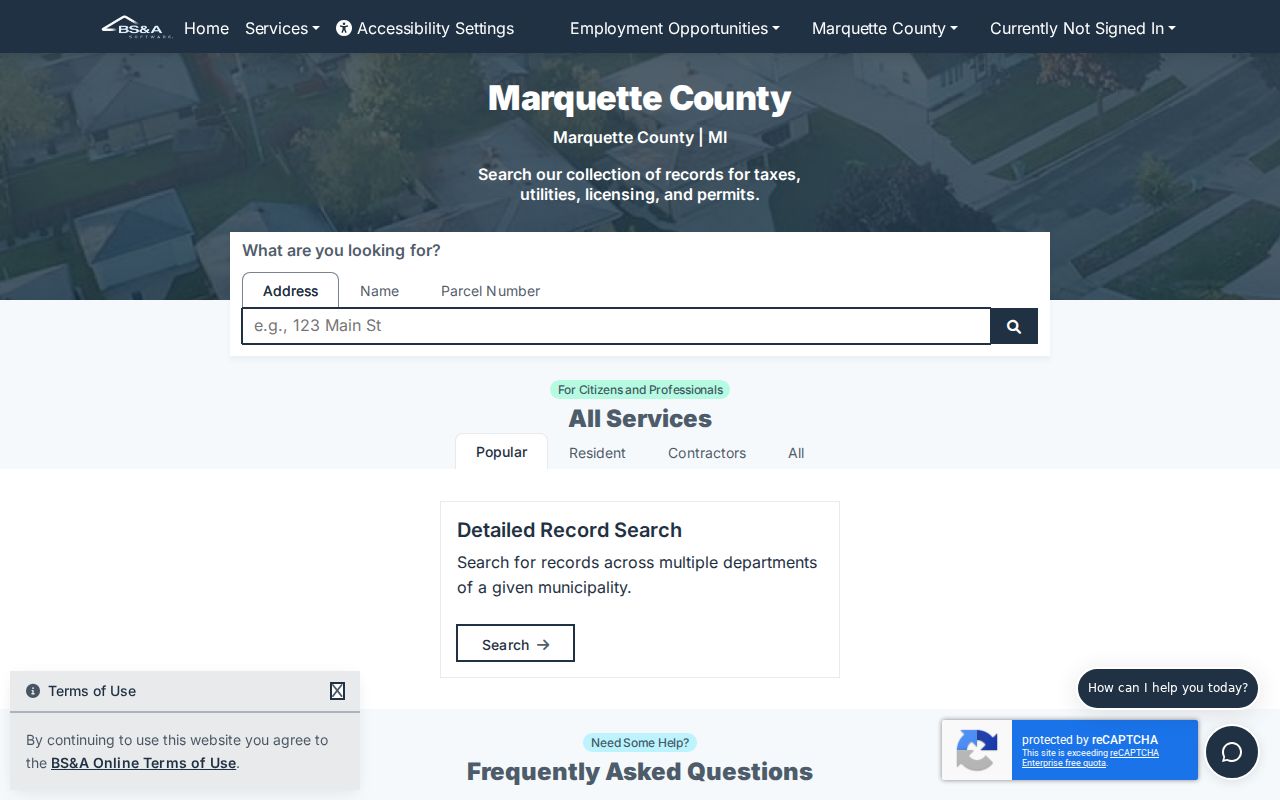
The official county page lists the counter, phone, and mail routes for records that never made it online.
Marquette County Deed Cutoffs
Dates shape every deed search in Marquette County. The online land index reaches back only to January 1, 1980. Mortgage and miscellaneous indexing starts even later, on January 1, 1983. The books themselves go back to the 1800s. So a thorough countywide search runs on two tracks: Tapestry or Laredo for the modern period, then the Register of Deeds counter and historic books for earlier transfers. This cutoff is one of the biggest limits in Marquette County property records.
The recorder also offers a free property-fraud alert. It watches newly recorded names and notifies enrollees. It does not block or validate any filing. The office also cautions residents to compare private deed-copy solicitations with the county's own copy prices before paying an outside sender.
Marquette County Tax Timing
Tax timing in Marquette County follows a fixed calendar. Cities and townships bill current real-property taxes in July and December. The local treasurer stays the payment contact through the last business day of February. On March 1, delinquent real-property tax moves to the County Treasurer. The county's basic online search is free. Detailed information carries a fee. An owner can view detail on their own property without charge after creating an account.
Longer histories are available too. The Treasurer can prepare up to 20 years of tax history from a taxpayer name and property number. Charges apply per tax billing, per parcel, per year. Anything older goes to NMU Archives. That makes the archive part of the official record trail rather than an optional extra.
Marquette County Records History
Marquette County has a long paper trail. It was set off in 1843 and fully organized by 1851, after years of attachments and boundary shifts. The Register of Deeds holds land records reaching into the 1800s. Marriage records begin in 1850 in cited local sources. Birth and death registers start in 1867, and Circuit Court material in 1869. These dates mark where each series begins, not a single start line. One property history can span many shelves. Deed books, court files, vital registers, tax rolls, newspapers, and plats all hold pieces.
The online layer is far younger. Deeds enter the digital run in 1980, with mortgages and miscellaneous instruments following in 1983. Current work may surface through BS&A, FetchGIS, MiCOURT, city planning packets, and the fraud-alert service. Older questions call for different shelves. The Library of Michigan's 1940 county-archives inventory helps. So do First Land Owners of Marquette County, 1850 census work, Archives of Michigan county groups, and NMU collections. Newspapers matter too. The Mining Journal and Daily Mining Journal help. So do the Negaunee Iron Herald and Ishpeming Iron Ore. They carry notices a deed book never saw. A clipping is a clue, though, not the property record itself.
That long timeline changes which key opens which door. A current urban parcel may yield to a street address and APN. An old mine, railroad, waterfront, or rural tract often does not. Try the addition name. Try lot and block, a section-township-range description, a company name, or a former street instead. Whatever the era, the legal description anchors the search across records old and new.
Marquette County Research Check
A careful Marquette County search leaves a paper trail of its own. Record the office, portal, date, APN, legal description, and exact name spelling used each time. The county seat offices at 234 W. Baraga Avenue house the Register of Deeds and County Clerk. Equalization works from the lower courthouse, and the Treasurer from the courthouse annex. A log matters here. Names collide. Parcel numbers never enter the online deed index. Postal cities cross unit lines.
When a record goes missing, the fallback depends on its keeper. Older land books sit with the recorder. Current tax bills belong to the local treasurer. Delinquent detail and histories sit with the County Treasurer. Equalization or Planning produces custom maps. The Clerk holds court files. Historic newspapers and county groups live at NMU and the state archives. Michigan FOIA offers a route when no special access law or portal controls the record. Name the record and date range you want. Do not ask an office for open-ended research. Certified copies, surveys, appraisals, and title opinions remain distinct products.
Record Dates Matter
Marquette County sources refresh on their own schedules. Save the search date, tax year, recording date, map date, and municipal unit. A later reader then knows which office held each fact. A newer deed can land before the next assessment update. An old planning packet may still hold a useful legal-description clue. It may not state the current result, though. When two sources disagree, contact both custodians and describe the difference plainly. Never settle a date by assumption.