
Marquette County Deed Records and What They Show
Deed records in Marquette County reach back to the 1800s. The Register of Deeds keeps them all. Marquette County deed records document every transfer of land. These run from early mining-era patents to today's warranty deeds and quitclaims. The office supports searching at a public counter. Online tools also extend the property search to anyone working from home. Start with a party name or a parcel number. Then follow the chain of ownership through the deed books, sale by sale. Anyone can search Marquette County property records by owner or parcel. That search can trace land title across generations.
| Deed Type | What It Does | Common Use |
|---|---|---|
| Warranty deed | Confirm the current field with the official custodian. | Confirm the current field with the official custodian. |
| Quitclaim deed | Confirm the current field with the official custodian. | Confirm the current field with the official custodian. |
| Grant / special warranty | Confirm the current field with the official custodian. | Confirm the current field with the official custodian. |
| Trustee / executor deed | Confirm the current field with the official custodian. | Confirm the current field with the official custodian. |
| Tax deed | Confirm the current field with the official custodian. | Confirm the current field with the official custodian. |
The archive at 234 W. Baraga Avenue runs deep. Records there reach the 1800s. The deed books document each transfer of Marquette County land since. The Register of Deeds offers several ways in. Tapestry charges 75 cents per search plus a per-page image fee. Laredo works as a subscription service for heavier deed-record use. Counter searching during weekday office hours reaches the older books directly. Copies are cheap. Plain pages cost a small per-page fee. A certified copy of a full document costs a flat certified rate. Plat copies run per page as well.
The Marquette County Grantor-Grantee Index
The grantor-grantee index is the front door to Marquette County deed records. Grantors are the sellers; grantees are the buyers. Look up either name. The index points you to the book and page of every recorded deed. The Register of Deeds at 234 W. Baraga Avenue maintains this index alongside land records reaching the 1800s. Online, Tapestry handles pay-per-search lookups at 75 cents each. Image pages are billed separately, and Laredo serves subscribers. For the oldest volumes, counter searching during weekday office hours works best. Copies stay affordable at a per-page rate, whether plain, certified, or plat.
- Record the source, date, parcel number, legal description, and office response before moving to the next source.
- Record the source, date, parcel number, legal description, and office response before moving to the next source.
- Record the source, date, parcel number, legal description, and office response before moving to the next source.
- Record the source, date, parcel number, legal description, and office response before moving to the next source.
- Grantor
- The party that transfers an interest.
- Grantee
- The party that receives the recorded interest.
- Chain of title
- The dated sequence of recorded transfers for the same legal description.
- Book/Page vs Instrument #
- Older books use book and page; newer records may use an instrument number.
Getting a Copy of a Marquette County Deed
Land records at the Marquette County Register of Deeds, 234 W. Baraga Avenue, reach back to the 1800s. The counter is open during weekday office hours. There, older deed books can be searched in person. Online, Tapestry charges .75 per search plus per image page, while Laredo works as a subscription service for regular users of Marquette County property records. Copies are straightforward: per page for ordinary copies, for a certified full document, and per page for plats.
Recorded, not guaranteed. The index shows recorded metadata and images, not a legal title opinion. Unrecorded interests may exist, so verify title through the appropriate professional process.
Offline Marquette County Access
Start any Marquette County deed search with two details. Pull the exact current owner and the legal description from BS&A or FetchGIS. Tapestry and Laredo both search by name and legal description, not by APN. Before buying an image, confirm the grantor, grantee, document type, recording date, instrument or book and page, and tract, and try name variants for trusts, estates, spouses, and entities. Pre-1980 transfers often need the courthouse counter, the tract index, the deed books themselves, the Archives of Michigan guide, or NMU archival holdings.
Online deed records still leave gaps. When a date range or image is missing, use the responsible counter, a telephone call, a mailed request, the Michigan FOIA route, or the named archive.
The official source shown here is the starting point for this record type.
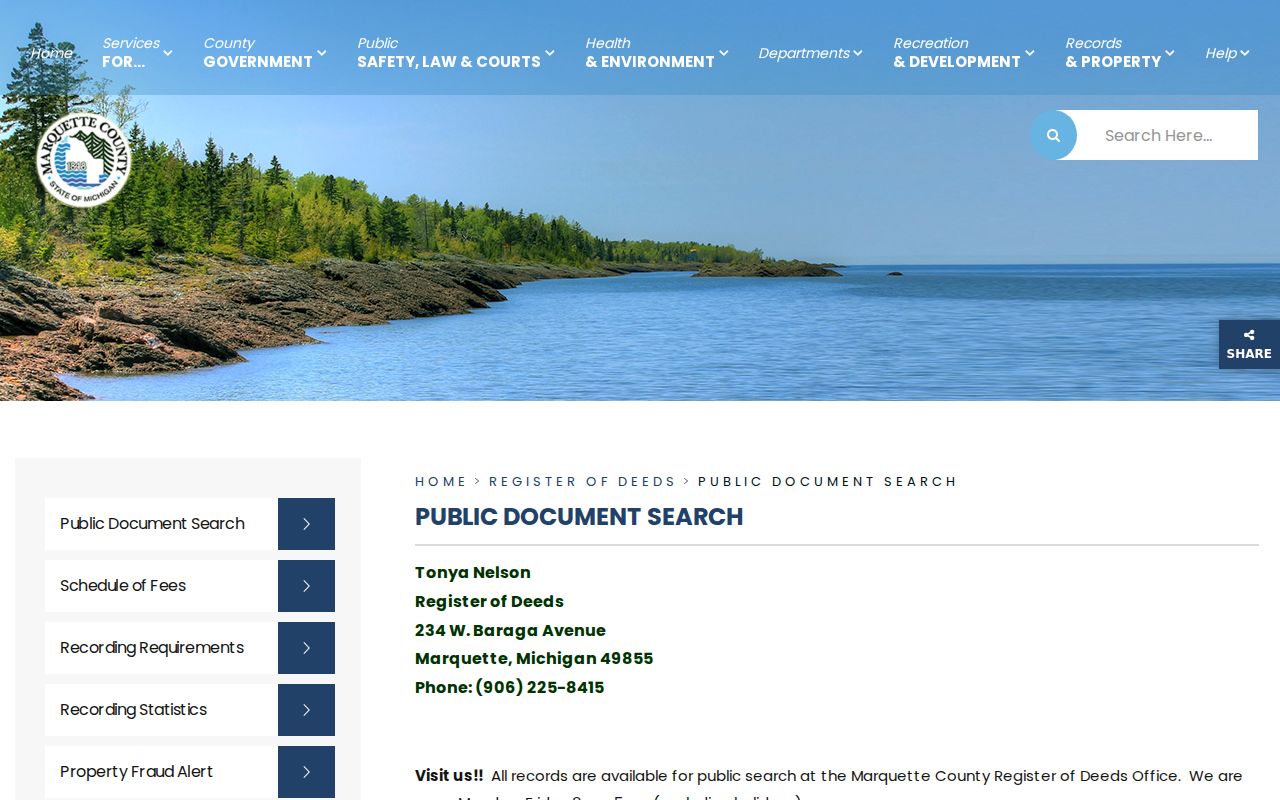
The county's official page displays the public access route for Marquette County deed records.
Marquette County Deed Charges
Marquette County charges to record a document, and that fee includes the first tax certificate. An added tax certificate costs more. Copies run per page for standard prints. A certified entire recorded document has its own rate, and plats run per page as well. A tract-index search costs for up to 25 descriptions. Each extra description adds 20 cents. These fees buy access and copies of property records. They do not buy legal advice or any title guarantee.
Michigan recording rules set clear format standards. Documents need readable dark print. They also need printed names beneath signatures, a grantee address, proper acknowledgment, and compliant page sizes and margins. A taxable deed must state the total consideration. A valuation affidavit must carry the prescribed statement. The Register of Deeds records eligible documents. It does not draft them or decide their legal effect.
Marquette County Plat Clues
Recorded plats keep names alive after streets change. Edward's Addition shows how. Its survey for Block 4 covers Lots 10, 11, 14, and 15, along with vacated Mesnard Street, monument notes, and document 2021R-15632. Ishpeming maps add Salisbury Location, Barnum variants, the U.S. Steel Assessor Plat, and Hard Ore Addition. Negaunee files tell a similar story. They lean on Iron Plat Addition and section-township-range descriptions.
Trust a plat name only after matching the legal description. A planning packet can surface a clue, yet a preliminary plat never becomes final just because it is public. Retrieve the recorded version, then confirm later deeds, easements, vacations, and replats against the same land.
Marquette County Instrument Trail
The recorder's books hold a wide family of instruments. Warranty and quitclaim deeds anchor most chains. Mortgages, assignments, and discharges trace the money side. Construction liens, releases, judgment liens, tax liens, lis pendens, easements, restrictive covenants, affidavits, probate deeds, foreclosure instruments, plats, replats, and condominium records round out the shelf. The county publishes no complete, stable document-type menu. Treat that list as a practical search vocabulary and confirm the live type with the recorder.
For a chain, open the newest deed. Note its grantor, grantee, recording date, reference, and legal description. Then search that grantor as the grantee on an earlier transfer, and repeat. Match the tract at every step. A shared surname on a different legal description is not part of the chain. Mortgage assignments and releases build a related encumbrance history, but they never substitute for the deed sequence.
Records can also point toward the courts. A lis pendens, foreclosure, quiet-title matter, or probate transfer may lead to case C25 or P52 in MiCOURT, then to the County Clerk for the actual file. The docket itself is informational. Compare the court disposition with any later recorded release, deed, or other instrument before stating that the land record changed.
Marquette County Research Check
Marquette County's free fraud alert is worth setting up. Set it once the correct owner of record has been pinned down. The alert tracks new recording activity under a name. It cannot stop fraud on its own. It also cannot judge whether a deed is valid. Nor can it take the place of reading the instrument itself. The Register of Deeds cautions residents about mailers charging steep prices for deed copies. Check any offer against the county fee schedule. Order certified copies straight from the office. Plan ahead before researching deed records in person. Bring every owner-name variant. Bring the legal description, rough transfer dates, and any book, page, or instrument number you have. Counter staff can steer you to the indexes and make copies. The office does not prepare documents, abstract titles, or offer legal advice. Some collections cited in archival guides sit with NMU partners. Call the repository before visiting. A solid deed-history memo should keep index metadata, a plain image, a certified copy, a planning plat, and a title professional's conclusion in separate lanes.